
In this Thesis we are dealing with the philosophy of global consciousness: a brief history of God. The most ancient written field theory of global consciousness is that of the Vedic rushis of ancient India, who lived around 1500 BC. These seers taught that an all-encompassing field of pure consciousness exists, as a universal Self called Atman or Brahman. This universal field of consciousness was said to be the sole and whole cause of all physical phenomena and to include within itself all individual human consciousnesses. The idea that each individual human consciousness is merely a partial manifestation of the all-pervading Atman/Brahman is expressed by such famous Vedic statements as “Thou art that” (tat tvam asi) and “I am he” (so ham). The state in which it is realized that ‘I am Brahman’ is called nirvikalpa-samadhi or changeless samadhi. The Brihadaranyaka Upanishad describes Atman as that in which everything exists, which is of the highest value, which permeates everything, which is the essence of all, bliss and beyond description. That Atman (self, soul) is indeed Brahman. It [Atman] is also identified with the intellect, the Manas (mind), and the vital breath, with the eyes and ears, with earth, water, air, and akasha (sky), with fire and with what is other than fire, with desire and the absence of desire, with anger and the absence of anger, with righteousness and unrighteousness, with everything — it is identified, as is well known, with this (what is perceived) and with that (what is inferred).


Commentaries On Predominent Upanishads
Original price was: ₹350.00.₹330.00Current price is: ₹330.00.
In this Thesis we are dealing with the philosophy of global consciousness: a brief history of God. The most ancient written field theory of global consciousness is that of the Vedic rushis of ancient India, who lived around 1500 BC. These seers taught that an all-encompassing field of pure consciousness exists, as a universal Self called Atman or Brahman. This universal field of consciousness was said to be the sole and whole cause of all physical phenomena and to include within itself all individual human consciousnesses. The idea that each individual human consciousness is merely a partial manifestation of the all-pervading Atman/Brahman is expressed by such famous Vedic statements as “Thou art that” (tat tvam asi) and “I am he” (so ham). The state in which it is realized that ‘I am Brahman’ is called nirvikalpa-samadhi or changeless samadhi. The Brihadaranyaka Upanishad describes Atman as that in which everything exists, which is of the highest value, which permeates everything, which is the essence of all, bliss and beyond description. That Atman (self, soul) is indeed Brahman. It [Atman] is also identified with the intellect, the Manas (mind), and the vital breath, with the eyes and ears, with earth, water, air, and akasha (sky), with fire and with what is other than fire, with desire and the absence of desire, with anger and the absence of anger, with righteousness and unrighteousness, with everything — it is identified, as is well known, with this (what is perceived) and with that (what is inferred).
Related products
-

-
Sale!
 New Book
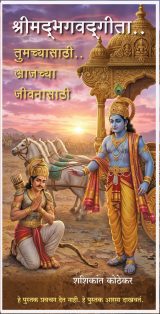
भगवद्गीता तुमच्यासाठी.. आजच्या जीवनासाठी (शशिकांत कोठेकार) BhagavadGita Tumchyasathi.. Aajchya Jivanasathi (Shashikant Kothekar)
Original price was: ₹125.00.₹120.00Current price is: ₹120.00. -
Sale!
 New Book
Bhagavad Gita For Gen Z (Shashikant Kothekar)
Original price was: ₹125.00.₹120.00Current price is: ₹120.00.
Reviews
There are no reviews yet.